Showing posts with label Allusion. Show all posts

Monday, July 23, 2012

Wait Till the Sun Shines Nellie

The previous song is a rendition of "Wait Till the Sun Shines, Nelly" with Bing Crosby and Mary Martin. According to Wikipedia, "Wait Till the Sun Shines, Nelly" was a popular 1905 song written by Harry Von Tilzer and lyrics by Andrew B. Sterling. Traditionally, floor traders at the New York Stock Exchange sing this song on the final trading day of every year, in addition to Christmas Eve, because the song has been the stock exchange anthem since 1934.
On page 156, Kurt Vonnegut alludes to this song by stating, "The barbershop quartet on the airplane was singing 'Wait Till the Sun Shines, Nelly,' when the plane smacked into the top of Sugarbush Mountain in Vermont. Everybody was killed but Billy and the copilot. So it goes."
Ah, how tragic! The barbershop is singing an incredibly upbeat and happy tune just before the plane crash. So it goes. (And - by the way - who doesn't love a good barbershop quartet? I can only think of one person who might disagree...)
After listening to that song a few times myself, I have already fallen in love. It's such a catchy tune! I immediately picture four men in dashing red-and-white-striped shirts, mustaches, suspenders, and white hats singing in perfect harmony while the audience applauds. Ah, 1905! The "Good Ol' Days!" I remember those years like they were yesterday... What? That's just me? Oh, alright.
The question now is, what purpose did Vonnegut have with the allusion to this song? Like I mentioned earlier, Vonnegut's purpose was to give the reader the image of everything working perfectly one second, and horribly the next. Everything is seemingly status quo in the plane with the quartet beautifully singing a fun, happy song (after singing a few crude, racist tunes) and tons of optometrists recalling old times. (Side note: What could a bunch of optometrists really talk about anyways? Example: Optometrist 1: Yeah, this patient of mine was nearsighted, but I accidentally told him he was farsighted. He walks into a door because he couldn't see! Hahahaha!
Optometrist 2: Hahahaha! Great story, Jim. One time I had this old lady who was as blind as a bat, so I gave her trifocals! And even then she couldn't see! Hahahaha... It was the funniest thing, you had to be there...... Yeah, sounds like a great plane ride....) Anyways, everything is going great, until- BANG! The plane crashes and no one saw it coming. Only two survive alive. The rest... weren't so lucky. So it goes.
So that's what I think Vonnegut's purpose was with "Wait Till the Sun Shines, Nelly." He was creating a mood of liveliness and happiness until, one second later, everything changes. I can immediately picture the scene. How tragic.

Thursday, June 14, 2012

King Croesus


In Chapter 3, Vonnegut continues his excellent allusions, anecdotes, diction, etc. On page 61, though, he takes his mastery one step further. He is able to mix an allusion with a simile at the same time. How is this possible? Because he's Vonnegut, that's why.
The quote I'm referring to is found in the middle of page 61, when Vonnegut refers to the rich life of Billy Pilgrim. The quote is, "[Billy] was rich as Croesus, something he had never expected to be, not in a million years." My first reaction after reading this sentence was, "Who is Croesus??? And why did Vonnegut refer to him? That's a nice simile though."
Consequently, I turned to Wikipedia. Wikipedia also describes Croesus' life as a very rich one, lived in extreme luxury as he ruled as King of Lydia of ancient Greece. He is credited with producing the circulation of the first gold coins in history. He is also famous for forming an alliance with Sparta during the Greek struggle against Persian onslaught. (I also learned that his name is not pronounced "crow-sus" and instead "cree-sus". It certainly still looks like Crow-sus to me, so that's what I'll call him from now on.)
Obviously, Vonnegut had a purpose in naming Crow-sus while describing Pilgrim's optometric riches. Netting $60 grand a year must have something to do with it. He also owned a share of a Holiday Inn and 3 Tastee-Freeze stands. But how is that comprable to a King of Lydia? The answer is that it's just a simile, so it doesn't have to be entirely accurate, but make a point that, in this case, Billy is much richer than he ever imagined an optometrist could be. Billy is living a life of luxury, and he is similar to Crow-sus because they both exceeded the typical living standards of other people in their respective cities and times.
So, with Vonnegut's epic allusion/simile combo of referencing Crow-sus, he is able to enthrall the reader with a connection to the ancient past. He also gives further explanation to just how extremely luxurious Billy's life was becoming.

Wednesday, June 6, 2012

Curse You, Google Translate

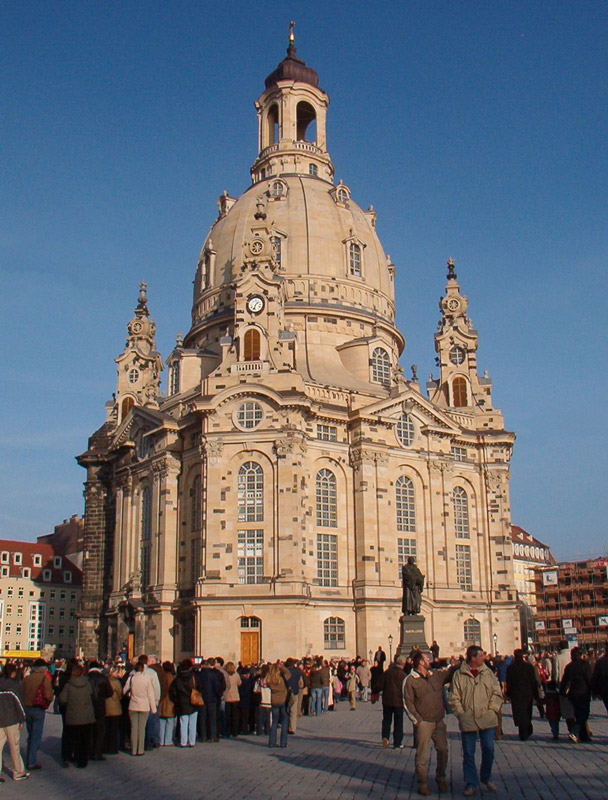
Posted above is a picture of the Frauenkirche (Church of Our Lady) in Dresden, Germany. Kurt Vonnegut briefly alludes to this magnificent church in Chapter 1 of SH-5.  However, when I read through the paragraph he mentions it, I skipped over it.
While in the O'Hare household, Vonnegut finds Dresden, History, Stage and Gallery by Mary Endell. On page 18, Vonnegut quotes Goethe's response to finding ruins in Dresden: "Von der Kuppel der Frauenkirche sah ich diese leidigen Trummer zwischen die schone stadtische Ordnung hineingesat; da ruhmte mir der Kuster die Kunst des Baumeisters, welcher Kirche und Kuppel auf einen so unerwunschten Fall schon eingerichtet und bombenfest erbaut hatte. Der gute Sakristan deutete mir alsdann auf Ruinen nach allen Seiten und sagte bedenklich lakonisch: Das hat der Feind gethan!" Is it Gibberish? No, not quite. Could I say it five times fast? No, and I hope I never have to.
Like most non-German students, when I read this passage, I rolled my eyes and skipped over it, while praying he would define the words for me I was curious to learn the meaning of these words, but unable to do so by myself. So, I naturally (and unsuccessfully) turned to Google Translate for help. (Note: do not use Google Translate for such a long passage because it is less helpful that way)  When I eventually discovered the meaning, this is what I found: "From the dome of the Church of our Lady I saw this loathsome rubble amongst the beautiful urban orderliness; whilst the verger boasted to me about the art of the master builder who built this church and the dome to withstand such an undesired event by making it bomb-proof. The good verger then pointed to all the ruins around us and said, reflectively and laconically; 'It was the enemy who did that!'"
After reading the translation, I was able to discover Vonnegut's purpose in alluding to such an extensive quote from Endell's book. If he wanted, couldn't he have left out Goethe's quote in his own book? The answer is, no. Goethe's quote emphasizes the devastation caused in Dresden, but proves the beauty of the Frauenkirche was built to last forever. The quote also proves that Vonnegut was seemingly dedicated to writing  his "Dresden book" yet unable to do so. Vonnegut tried hard to write an entire book about Dresden, yet something in him was just not quite capable of doing so. This first chapter emphasizes the struggles Vonnegut encountered while trying to write this book, and this quote is a perfect example of his dedication.
As for me, I remain angry with Google Translate for making me go through so much trouble to find the correct translation. If Google Translate ever again makes me do extra summer work, I will say: "Das hat der Feind gethan!"